


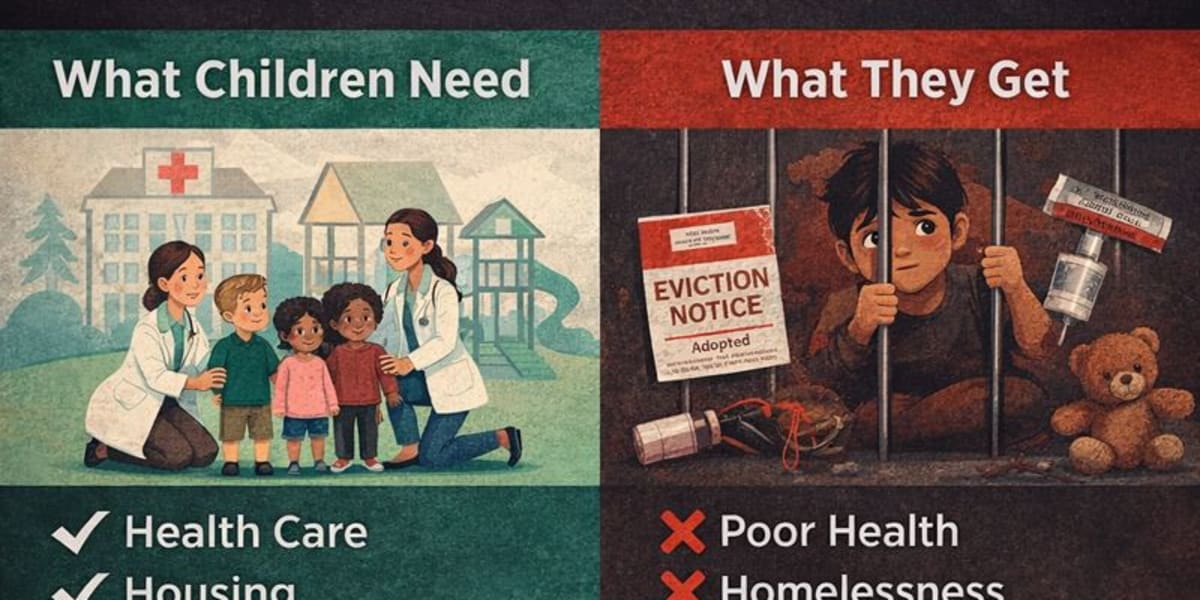
As parents and as a society, we make an implicit promise to our children: to support, invest in, and protect them—because they are both our present and our future. This isn’t charity. It’s a foundational obligation: the difference between a thriving civilization and decline.
In just the last week, federal policymakers have taken action after action that will make children’s lives harder, sicker, poorer, and more dangerous. It’s not an exaggeration – it’s a pattern. One that anyone who cares about kids can no longer afford to overlook.
Children today need help. Desperately. They need health care, education, nutrition, housing, safety, support, and love – not because they’re special interests, but because they’re children. Because they’re still growing. Because their brains and bodies are still developing. Because their well-being now determines the health of our future as a country. And because they depend on adults to do right by them.
And yet, our government is not offering help. It is actively doing harm.
We are not talking about a single cut or one unfortunate oversight. We are talking about a systemic and escalating assault and abandonment of children across nearly every area of public policy: health, immigration, nutrition, safety, and support. The very systems meant to protect them are being dismantled in real time.
Children are not being left behind. They are being targeted. And we have a responsibility to call it what it is.
Let’s start with what children need. It’s not abstract. It’s not controversial.
-
Preventive and ongoing medical care
-
Safe, stable housing
-
Healthy meals and clean water
-
An early start with high quality early childhood programs
-
A strong public education system
-
Freedom from violence
-
Belonging, dignity, and protection
These are not luxuries. These are the bare minimum conditions for healthy childhood development, but they are increasingly out of reach.
Children in America today are facing:
These conditions demand urgent, bold action. But instead of a policy agenda that responds to this crisis, we are watching a policy agenda that abandons them altogether.
There are two competing paths in American child policy right now:
-
In one, children would be supported to grow, develop, survive, and thrive
-
Unfortunately, the other path is being enacted at their expense and peril
And perhaps most striking of all: every single federal action we’ve seen this week does not just fall short – it does active harm to children. This is not about what’s missing. It’s about what’s being taken away.
What we are seeing is what organized abandonment looks like: it is not accidental. It is not the result of budget constraints or competing priorities. It is the systematic dismantling of the infrastructure of care – the programs, protections, and the people who stand up to protect children from harm. It is the government stepping back while simultaneously tying the hands of everyone else who would step forward.
Organized abandonment operates on multiple levels:
First, it withdraws the resources children need: funding, programs, and protections.

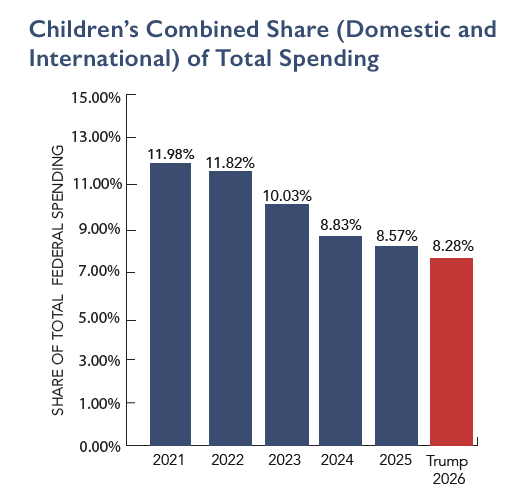
Source: First Focus on Children, Children’s Budget 2025
Second, it punishes those who continue to provide support – defunding the American Academy of Pediatrics for standing up for science and children, attacking school nurses for providing students a band-aid without parental consent, threatening doctors who provide gender-affirming care, and intimidating people who are trying to support and protect immigrants.
Third, it spreads fear that causes families to abandon help even when it remains technically available – the chilling effect of public charge rules that make parents disenroll their own children from health, nutrition, and early childhood programs.
Fourth, it erases children from policy consideration entirely – health subsidies that mention adults but not kids, legislation that treats children as invisible.
That is not neglect. This is not oversight. This is policy. And we will see it play out again and again in the actions detailed below.
The following are not a complete accounting of recent events – it is, however, a shocking list of policies that have negative implications for children in a short period of time. Each action, on its own, would be alarming. Together, they reveal a pattern of coordinated harm.
1. A Dangerous Retreat from Childhood Vaccination
The CDC’s vaccine advisory committee recently voted to eliminate the recommendation that all infants receive the hepatitis B vaccine at birth. This is a shocking reversal of decades of public health guidance.
For years, this recommendation has been a cornerstone of early childhood protection, helping reduce hepatitis B transmission and offering infants lifesaving coverage, regardless of social status or parental history.
Rolling it back sends the wrong signal at the worst time. It shifts the burden to parents and doctors to assess individual risk, in a landscape flooded with misinformation and fear.
This retreat comes amid a dangerous resurgence: nearly 2,000 measles cases have now been reported, and some schools are shutting down to contain exposure.
The message? That parents are on their own. That science is optional. That the state no longer considers universal protections for babies a priority. This is organized abandonment at the most vulnerable moment of life – birth itself.


2. Defunding the American Academy of Pediatrics: Silencing Science, Abandoning Care
This week, the American Academy of Pediatrics learned that seven federal grants totaling over $18 million that were abruptly terminated. Not paused. Not reviewed. Terminated.
These grants supported the very backbone of child health progress:
-
Preventing sudden infant death syndrome (SIDS)
-
Identifying autism earlier
-
Supporting children with birth defects
-
Preventing fetal alcohol spectrum disorders
-
Expanding pediatric care in rural communities
-
Improving youth mental health
These grants weren’t cut because they failed. They were cut because the AAP has continued to stand up for evidence-based vaccine safety, speaking out against the politicization of child health.
This is the definition of organized abandonment: the government not only walking away from its responsibility, but punishing those who continue to fulfill theirs.
Parents are being left without support. Pediatricians are being silenced. And children are being left exposed, again.


3. Gender-Affirming Care: Parental Rights for Some, Not All
The federal government – both the Department of Health and Human Services (HHS) and the U.S. House of Representatives – are moving to ban gender-affirming care for children under 18 across all federal health programs, threatening hospitals and physicians who provide such care, even in states where it’s legal and affirmed by medical associations.


Let’s be clear: this is not about protecting children. It is about overriding their families and their doctors.
It is about a government stepping in to say: your identity isn’t valid. Your care doesn’t matter. Your parents don’t get to decide.
It is profoundly hypocritical for an administration to invoke “parental rights” in eliminating vaccine mandates – only to then strip both parental and child rights when families seek evidence-based gender-affirming care.
The parents who are deemed capable of making decisions are overwhelmingly those whose choices align with a particular political ideology. Parents who want their children vaccinated against measles are told the government cannot even make recommendations in support of protecting children. But for parents seeking gender-affirming care requested by their child and recommended by their child’s doctor are told – in this case – that government knows better.
This is not just policy inconsistency. It is targeted harm. It is the weaponization of “parental rights” to mean only certain parents, making only certain choices, and for only certain children.


4. Strip Searches, Family Separation, and State Violence
This week, the House passed a bill endorsing strip searches of unaccompanied migrant children, eliminating longstanding child welfare protections in immigration custody.
These are children – many fleeing violence, war, or trafficking – who are now being treated not as vulnerable youth in government care, but as suspected criminals.
Let’s name what this is: a direct violation of human rights. Strip searches of children are traumatizing, unnecessary, and morally abhorrent.


Children in custody are the government’s responsibility. That responsibility is to protect, not dehumanize. When we permit or even encourage the strip searching of children, we have abandoned not just policy but basic human decency.
5. Expanding Public Charge: Chilling Access to Basic Survival
In one of the most quietly devastating developments, the Administration is expanding the scope of “public charge” rules to include non-cash benefits, such as Head Start, Medicaid, WIC, and SNAP.
The implications are enormous.
Already, public charge policies have created a massive chilling effect, where immigrant parents disenroll their U.S. citizen children from essential programs out of fear of future immigration penalties.
According to the child-focused comment letter we signed:
-
Families are avoiding health care, nutrition programs, and early learning out of fear
-
Children’s health outcomes are worsening due to missed screenings, delayed treatment, and school absences
-
The rule disproportionately harms children of color in mixed-status families
-
It undermines public health goals and deepens inequality
Children are not technically subject to the rule, but they suffer its worst effects. This policy doesn’t just fail kids – it punishes them for being born into the “wrong” family.
6. Health Subsidies That Exclude Children
In the Senate, a new healthcare proposal by Sen. Bill Cassidy (R-LA) entitled the Health Care Freedom for Patients Act would provide adults with $1,000 to $1,500 to deposit into Health Savings Accounts. But when it comes to kids? Nothing.


At a time when over 4 million children are uninsured, and families are losing coverage as pandemic protections unwind, this omission is not a footnote. It is a flashing red warning sign.
Children have been left out of the debate entirely.
When policymakers draft health care proposals and children don’t even warrant a line item, we are witnessing a continued pattern of invisibility and erasure. Children are being literally written out of legislation, as if they don’t exist, as if they don’t need health care, as if their suffering is worthless.
7. Birthright Citizenship on the Chopping Block
The Supreme Court may soon consider efforts to end birthright citizenship, a constitutional guarantee that children born on U.S. soil are citizens – regardless of their parents’ immigration status.
The implications? Babies born in America could be denied U.S. citizenship.
This would create a class of children who are stateless, unprotected, and legally invisible. It violates the 14th Amendment and the very notion of equal dignity at birth.
We cannot allow a child’s rights to be determined by bloodline or bureaucracy. Citizenship is not a privilege: it is a promise. When we break that promise, we create a permanent underclass of stateless children who will grow up in the shadows of their own country – present but not recognized, here but not belonging.
8. USAID Cuts and the Global Abandonment of Children
Even outside our borders, children are being abandoned. The U.S. has slashed support for global child health programs – vaccinations, nutrition, sanitation – through the elimination of key USAID investments.
The result? Rising child mortality, especially in conflict zones and famine-affected regions. In Yemen, an estimated 10,000 more children will die of preventable diseases this year. In the Democratic Republic of Congo, vaccination rates are expected to drop by 40%.
As Brooke Nichols, an associate professor of global health at Boston University, said to NPR:
Sometimes we talk about numbers. Oh, this is an increase in mortality, a percent increase. What is a percent? It’s a human. It’s a child. It could be your child. It could be my child.
Our failure to care for children globally reflects a deeper truth: we are losing our moral compass, one child at a time. Organized abandonment knows no borders. When we withdraw and turn our backs on our obligations to the world’s most vulnerable children, we declare that some lives simply don’t matter.
9. Gun Violence and the Trauma of Youth
At Brown University this week, a campus shooting sent students into lockdown. Some of them had already endured school shootings as children.


This is the cycle we are creating: trauma that begins in childhood and follows kids into adulthood, reshaping lives, robbing futures, and normalizing the unthinkable.
Consider the lived reality: children as young as give now participate in active shooter drills. They learn to hide in closets, to be silent, to play dead. They learn that adults cannot keep them safe. This is the normalization of terror.
And when mass shooting occur, as they do with horrifying regularity in this country, some of the young people sheltering at Brown University were previous survivors of other active shooter incidents when they were in elementary or high school.
We have the power to end this. But instead, we are turning away. We are organizing the abandonment of children to a future of perpetual fear, trauma, and preventable death.
10. Epstein Files: Protecting the Abusers and Not the Child Victims
The recent unsealing of the Epstein files revealed more than the sordid details of one man’s crimes. It revealed a system—spanning law enforcement, legal settlements, and elite networks—that chose again and again to protect abusers while silencing or ignoring victims.
At the center of it all? Children who were exploited, disbelieved, and discarded.
This is not just a scandal. It is a case study in how power shields itself while children pay the price.
Where were the investigations when they were first called for?
Where was the outrage when victims came forward?
Where were the systems of protection that should have made abuse impossible?
In the wake of these revelations, too much of the public conversation has focused on who was named—and too little on why justice never came for the girls harmed by Epstein and those in his circle.
It is yet another example of how our institutions protect reputations over children, delay accountability until it’s politically convenient, and allow the abuse of young girls to continue in silence.
The Epstein case is not an outlier. It is a window. And we ignore what it shows us at our peril.


These are not isolated failures. They are part of a political strategy rooted in fear and identity.
Notice the pattern: the children being targeted share something in common – they exist at the intersection of marginalized identities.
-
The children of immigrants: public charge rules, strip search of unaccompanied children, and birthright citizenship attacks
-
Children of color: disproportionately affected by all of the above
-
LGBTQ+ youth: gender-affirming care bans
-
Poor children: targeted for Medicaid and SNAP cuts earlier in the year, denied the full Child Tax Credit, and facing increased hunger and homelessness
-
Children with disabilities: losing early autism screening, rural care access, specialized support programs
This is not coincidence. This is strategy. By attacking children through the lens of their identity, policymakers can frame their harm as oppositional (e.g., “those kids” and “those undeserving families”). It strips these children of humanity in service of ideology.
The process of “othering” works through several mechanisms:
-
When politicians want to attack public school and libraries, they embrace culture wars and put up a sign on a podium reading “Parental Rights” and a banner behind the podium reading “Putting Parents First” with the intent of undermining the supportive role of public schools, teachers, school nurses, counselors, and librarians to children.
-
When politicians want to target children and families for cuts, they can’t attack children directly, as that would be unpopular, and so they question the “deservingness” of some of the same parents they just applauded by “otherizing” immigrants, single mothers, and women of color.
-
Fear and misinformation are leveraged, and anecdotal stories are used to question scientists as profit seekers, immigrants as criminals, and child-serving adults as groomers.
-
Cruelty is normalized, which makes each new policy easier to accept, as adults and some children are stripped of humanity in service of ideology.
This is not how a moral society treats its children.
We must rethink what “parental rights” means and what it doesn’t.
Parental rights cannot be a one-size-fits-some slogan. They must be balanced with children’s rights, children’s best interests, and children’s needs.
Politicians, including various Administration officials, invokes parental rights selectively, as a shield for some families and a weapon against others. Consider the contradictions:
-
Parents have the “right” to refuse vaccines for their children, even during a measles outbreak that puts other children at risk
-
But if their child gets sick and needs care, parents rely upon those same medical professionals to serve and treat their children
-
School nurses, athletic trainers, and school counselors can be told not to care for children without parental consent
-
But if parents seek gender-affirming care for their transgender child, even when the child seeks care and medical professionals recommend it, government can act to deny care
Real support for children and families requires:
-
Access to pediatric expertise and evidence-based medical care
-
Resources for nutrition, housing, and economic security
-
Resources for education, early childhood development, and child care
-
Safety from violence and environmental hazards
Parental rights must also be balanced with children’s independent rights because children are not property. They have their own interests, concerns, needs, and dignity.
When “parental rights” becomes a cover for removing support and overriding medical judgment, it fails both parents and children. It becomes a rhetorical tool for organized abandonment – a way to justify doing nothing while blaming parents for poor outcomes.
When policies harm children, they do not operate in isolation. They create cascades of harm where one injustice leads to another, when a child who starts with one disadvantage accumulates many more. Our juvenile justice system is made up of kids who are failed by other systems of care.
In America today, politicians say they are concerned about declining birth rates but the President signed an Executive Order (EO) that threatens the citizenship and, thereby, Medicaid, WIC, and SNAP of babies all across the country. If mothers suffer a loss of income during pregnancy and childbirth, as most do, they may be denied the Child Tax Credit because they made “too little” to qualify for the full credit.
When the child was born, they may not have received the hepatitis B vaccine because the Centers for Disease Control and Prevention (CDC) no longer recommends it. If the child develops a preventable health condition, the family may not have health insurance due to over $900 billion in Medicaid cuts, the lack of subsidies for the child in the Affordable Care Act, or due to denial of care and treatment related to the “public charge” rule for immigrant families.
At age 5, the child’s school may to closed due to a measles outbreak. The child falls behind academically during the closure, and their parents lose income when they can’t work. At age 7, the child participates in their first active shooter drill and begins having nightmares and anxiety, but there are no mental health services available due to program cuts.
This is the America we are building, one policy failure at a time. This is what organized abandonment looks like and what happens when we treat children as an afterthought rather than as a primary concern and obligation.
Our political leaders are not removing one thread from the safety net – they are systematically cutting every strand under children fall through into nothing.
Here is the painful reality: at the moment when kids most need advocacy, the child advocacy field is shrinking.
We recently lost a grant because a funder didn’t want to be associated with advocacy. Across the field, groups are facing declining donations, hostile policy environments, and increased risk.
Meanwhile:
-
More children are hungry
-
More families are being evicted
-
More schools are locking down
-
More kids are being stripped of services and status
-
More children are dying of preventable causes – both here and abroad
If your neighbor’s house was on fire, you wouldn’t debate whether their family “deserved” help or whether they should have rewired their house and bought better smoke detectors. You would act. America’s children are suffering, and we are discussing whether they have the right parents or the right documentation to receive health care and food.
We need your voice. Your partnership. Your support.
· Donate to child advocacy organizations.
· Support groups who speak for children in policy.
· Share this piece. Talk to your networks. Raise your voice.
Because kids can’t wait.
Because kids can’t vote.
Because kids can’t fight alone – but we can and must fight for them.
The question for us is not whether we have the resources to invest in and protect children. The question is whether we have the will.
The betrayal of the social contract between generations is growing. The question now is whether we will accept it or whether we will fight to restore the promise every society must make to its children: we will invest in you, protect you, and never abandon you.
What You Can Do:
As we near the close of the year, please consider either:
link