
Personalized Nutrition and Supplements Market Forecast and Outlook 2025 to 2035
The global personalized nutrition and supplements market is projected to grow from USD 15.97 billion in 2025 to approximately USD 64.35 billion by 2035, the market will rise at a CAGR of 15.0% which recording an absolute increase of USD 48.38 billion over the forecast period. This translates into a total growth of 303.0%, with the market forecast to expand at a compound annual growth rate (CAGR) of 15.0% between 2025 and 2035.
Quick Stats for Personalized Nutrition and Supplements Market
- Personalized Nutrition and Supplements Market Value (2025): USD 15.97 billion
- Personalized Nutrition and Supplements Market Forecast Value (2035): USD 64.35 billion
- Personalized Nutrition and Supplements Market Forecast CAGR: 15.0%
- Leading Ingredient in Personalized Nutrition and Supplements Market: Vitamins (30.2%)
- Key Growth Regions in Personalized Nutrition and Supplements Market: Asia Pacific, North America, and Europe
- Key Players in Personalized Nutrition and Supplements Market: Amway Corp., Abbott, Superior Supplement Manufacturing, Herbalife International of America, Inc., Metagenics, Inc., Fagron Genomics S.L.U., Nutralliance, DNAfit, Archer Daniels Midland Company, Viome Life Sciences, Inc.
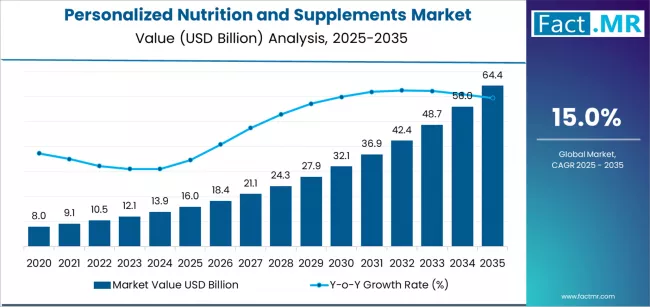
The overall market size is expected to grow by nearly 4.0X during the same period, supported by increasing consumer demand for customized health solutions, rising adoption of AI-driven nutritional assessment technologies, and growing emphasis on preventive healthcare optimization across global wellness operations.
Vitamins account for 30.2% of the market by ingredient due to widespread consumer recognition and established efficacy in addressing nutritional deficiencies across demographic segments. This segment addresses fundamental requirements for micronutrient supplementation and immune system support in personalized wellness programs. Within ingredient categories, proteins and amino acids demonstrate significant momentum, reflecting growing consumer preference for targeted muscle health, metabolic optimization, and sports nutrition applications.
Probiotics represent substantial market potential in applications where gut health management, digestive wellness, and microbiome optimization are prioritized, particularly in preventive health programs and chronic condition management protocols where targeted bacterial strains enhance health outcomes. Advances in genomic testing, biomarker analysis technologies, and precision formulation protocols are improving supplementation accuracy and health optimization efficiency across consumer wellness networks.
Dosage form dynamics reveal tablets and capsules commanding 60.8% market share, driven by consumer familiarity, portability advantages, and precise dosing capabilities in daily supplementation routines. This format addresses convenience requirements and compliance considerations while maintaining stability across diverse ingredient formulations.
Powders represent growing demand, highlighting consumer preference for flexible dosing and rapid absorption characteristics in fitness and meal replacement applications. Liquid formulations demonstrate distinct advantages in specialized nutrition programs requiring immediate bioavailability and enhanced palatability for specific demographic segments.
Distribution channel segmentation shows online pharmacies and e-commerce sites leading at 40.5% share, reflecting the digital transformation of personalized health services and direct-to-consumer business model adoption. This channel enables comprehensive health assessment integration, subscription-based delivery models, and personalized recommendation algorithms that align with modern consumer purchasing behaviors. Adults command a 69.6% market share by age group, highlighting the segment’s focus on preventive health optimization, performance enhancement, and age-related health maintenance across working-age populations.
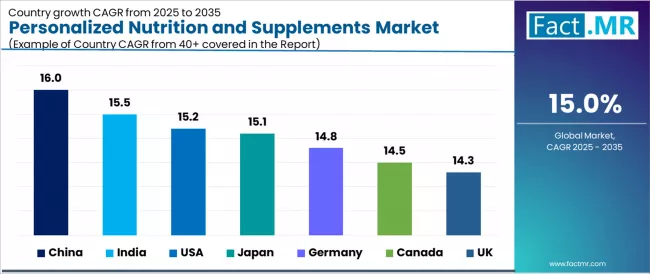
Regionally, Asia Pacific leads growth, with China (16.0% CAGR) and India (15.5% CAGR) driven by rapid urbanization, expanding middle-class populations with disposable income growth, and increasing integration of AI-powered health platforms across emerging digital health ecosystems.
North America demonstrates strong momentum, with the USA (15.2% CAGR) and Japan (15.1% CAGR) supported by high consumer health awareness, advanced personalized supplement technologies, and established preventive healthcare adoption in mature wellness markets.
European markets such as Germany (14.8% CAGR), Canada (14.5% CAGR), and UK (14.3% CAGR) show robust growth tied to aging population demographics, preventive healthcare emphasis, and subscription-based personalized vitamin service expansion in developed wellness economies.
Between 2025 and 2030, the personalized nutrition and supplements market is projected to expand from USD 15.97 billion to USD 31.70 billion, resulting in a value increase of USD 15.73 billion, which represents 32.5% of the total forecast growth for the decade. This phase of development will be shaped by rising demand for DNA-based nutritional recommendations, increasing applications in chronic disease prevention programs, and growing penetration in fitness and athletic performance optimization. Wellness companies are expanding their personalization capabilities to address the growing demand for data-driven health solutions and customized supplementation protocols across various demographic segments and health optimization categories.
From 2030 to 2035, the market is forecast to grow from USD 31.70 billion to USD 64.35 billion, adding another USD 32.65 billion, which constitutes 67.5% of the overall ten-year expansion. This period is expected to be characterized by the expansion of artificial intelligence-driven formulation systems, the integration of continuous health monitoring technologies, and the development of specialized formulations for precision medicine applications. The growing adoption of microbiome testing protocols and metabolic profiling services will drive demand for ultra-personalized supplement systems with enhanced bioavailability specifications and consistent health outcome characteristics.
Personalized Nutrition and Supplements Market Key Takeaways
| Metric | Value |
|---|---|
| Estimated Value in (2025E) | USD 15.97 billion |
| Forecast Value in (2035F) | USD 64.35 billion |
| Forecast CAGR (2025 to 2035) | 15.0% |
Why is the Personalized Nutrition and Supplements Market Growing?
Market expansion is being supported by the increasing demand for individualized health solutions and the corresponding need for high-quality personalized supplements in wellness applications across global consumer markets.
Modern health-conscious consumers are increasingly focused on advanced supplementation systems that can improve health outcomes, address specific nutritional deficiencies, and enhance overall wellness while meeting individual genetic and lifestyle requirements.
The proven efficacy of personalized nutrition approaches in various health applications makes them an essential component of comprehensive preventive healthcare strategies and wellness optimization programs.
The growing emphasis on preventive healthcare and wellness optimization is driving demand for scientifically validated personalized supplements that meet stringent quality specifications and individual health requirements for nutrition applications.
Consumers’ preference for data-driven, customized health solutions that can ensure targeted nutritional outcomes is creating opportunities for innovative formulation approaches and genomic-based supplementation protocols.
The rising influence of digital health platforms and precision medicine frameworks is also contributing to increased adoption of premium-grade personalized supplements across different demographic segments and health conditions requiring advanced personalization technology.
Opportunity Pathways – Personalized Nutrition and Supplements Market
The personalized nutrition and supplements market represents a transformative growth opportunity, expanding from USD 15.97 billion in 2025 to USD 64.35 billion by 2035 at a 15.0% CAGR. As consumers prioritize health optimization, disease prevention, and performance enhancement through individualized approaches, personalized supplement systems have evolved from a niche wellness concept to an essential component enabling precision health management, targeted nutritional intervention, and data-driven wellness optimization across healthcare ecosystems and consumer health applications.
The convergence of genomic testing accessibility, artificial intelligence advancement, wearable health technology integration, and preventive healthcare adoption creates momentum in demand. Premium formulations offering scientifically validated personalization, subscription-based delivery models balancing convenience with customization, and specialized variants for specific health conditions will capture market premiums, while geographic expansion into high-growth Asian consumer markets and emerging market penetration will drive volume leadership. Consumer emphasis on health outcome validation and wellness optimization provides structural support.
Segmental Analysis
The market is segmented by ingredient, dosage form, distribution channel, age group, and region. By ingredient, the market is divided into proteins and amino acids, probiotics, herbal/botanicals, vitamins, minerals, and others. Based on dosage form, the market is categorized into tablets/capsules, powders, liquids, and others.
By distribution channel, the market is divided into specialty stores, online pharmacies and e-commerce sites, supermarkets/hypermarkets, and retail pharmacies. By age group, the market is divided into pediatric, adults, and geriatric. Regionally, the market is divided into North America, Europe, Asia Pacific, Latin America, and Middle East & Africa.
By Ingredient, What Drives Vitamins Segment Market Leadership?
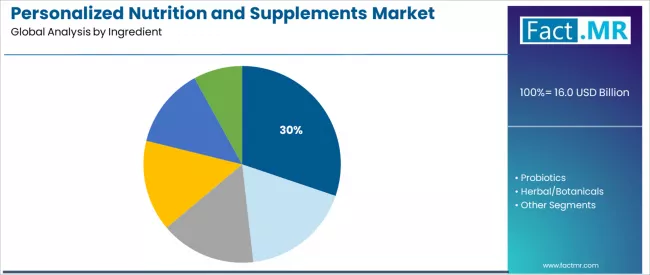
The vitamins segment is projected to account for 30.2% of the personalized nutrition and supplements market in 2025, reaffirming its position as the category’s dominant ingredient. Health-conscious consumers increasingly recognize the fundamental role of vitamin supplementation in addressing micronutrient deficiencies and supporting immune system function across personalized wellness programs.
Vitamins address both preventive health requirements and targeted deficiency correction while providing scientifically validated benefits across diverse demographic segments and health objectives. This ingredient forms the foundation of most personalized supplementation protocols, as it represents the most widely researched and clinically validated nutritional component in the wellness industry.
Bioavailability enhancement technologies and extensive clinical testing continue to strengthen consumer confidence in personalized vitamin systems among health practitioners and wellness providers. With increasing recognition of the individualized nutrient requirements and optimal health maintenance needs, personalized vitamin systems align with both preventive healthcare and performance optimization goals, making them the central growth driver of comprehensive wellness strategies.
By Dosage Form, how do Tablets and Capsules Command Market Dominance?

Tablets and capsules dosage form is projected to represent 60.8% of personalized nutrition and supplement demand in 2025, underscoring its role as the primary format segment driving market adoption and growth.
Consumers recognize that tablet and capsule requirements, including precise dosing capabilities, extended shelf stability, and convenient portability, often provide standardized delivery that conventional liquid or powder formats cannot adequately match. Personalized supplements in tablet and capsule form offer enhanced compliance convenience and consistent dosing optimization in daily supplementation routines.
The segment is supported by the established nature of solid dosage form adoption, requiring minimal consumption modification, and the increasing recognition that tablet and capsule formulations can deliver reliable bioavailability and storage advantages. Additionally, consumers are increasingly adopting standardized supplementation protocols that accommodate tablet and capsule integration for optimal adherence outcomes.
As understanding of bioavailability optimization advances and personalization requirements become more sophisticated, tablet and capsule formulations will continue to play a crucial role in comprehensive supplementation strategies within the personalized wellness market.
By Distribution Channel, Why Do Online Pharmacies and E-commerce Sites Lead Market Share?

The online pharmacies and e-commerce sites segment is projected to account for 40.5% of the personalized nutrition and supplements market in 2025, establishing its position as the leading distribution category.
Consumers increasingly recognize the integration advantages of digital platforms that combine health assessment tools, personalized recommendation algorithms, and convenient home delivery systems. This distribution channel addresses both accessibility requirements and personalization service integration while providing seamless consumer experiences across digital wellness ecosystems.
The segment is supported by the digital transformation of healthcare services, enabling comprehensive health data collection, and the increasing recognition that online platforms can deliver superior personalization and subscription convenience.
Consumers are increasingly adopting direct-to-consumer models that recommend specific supplement formulations based on individual health assessments for optimal outcome achievement. As understanding of personalized health optimization advances and consumer expectations become more demanding, online distribution channels will continue to play a crucial role in comprehensive wellness delivery strategies within the personalized supplement market.
By Age Group, What Establishes Adults Segment Market Prominence?
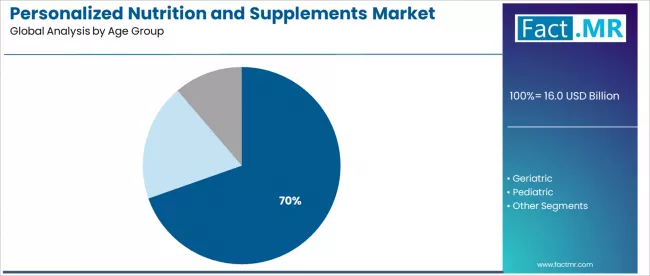
The adults age group segment is projected to account for 69.6% of the personalized nutrition and supplements market in 2025, establishing its position as the dominant demographic category. This segment represents working-age populations focused on preventive health optimization, performance enhancement, stress management, and age-related health maintenance across demanding lifestyle contexts. Adults demonstrate heightened awareness of personalized health solutions and possess purchasing power for premium supplementation programs.
The segment is supported by the proactive health management behaviors characteristic of adult demographics, requiring comprehensive nutritional support, and the increasing recognition that personalized supplementation can improve energy levels, cognitive function, and chronic disease prevention outcomes. Additionally, adults are increasingly adopting evidence-based wellness protocols that recommend specific personalized formulations for optimal health outcomes based on individual biomarkers and lifestyle factors. As understanding of precision nutrition advances and health optimization requirements evolve, personalized supplements will continue to serve a crucial role in comprehensive wellness strategies within the adult consumer market.
What are the Drivers, Restraints, and Key Trends of the Personalized Nutrition and Supplements Market?
The personalized nutrition and supplements market is advancing rapidly due to increasing recognition of individualized health approaches and growing demand for precision wellness systems across the consumer health sector. However, the market faces challenges, including personalized supplement premium pricing considerations, potential for consumer skepticism regarding personalization efficacy validation, and concerns about data privacy in genetic and health information collection for specialized wellness applications. Innovation in AI-driven formulation algorithms and accessible genetic testing protocols continues to influence product development and market expansion patterns.
Expansion of Genomic Testing Accessibility and AI-Driven Health Platforms
The growing adoption of direct-to-consumer genetic testing is enabling the development of more sophisticated personalized supplement applications and nutritional recommendation systems that can meet individual genetic requirements.
Digital health platforms offer comprehensive capabilities for personalized supplements, including DNA-based formulations and microbiome analysis protocols that are particularly important for achieving optimal health outcomes in precision wellness applications.
Advanced personalization technologies provide access to individualized nutrient profiles that can optimize health performance and address specific deficiencies while maintaining cost-effectiveness for subscription-based wellness programs.
Integration of Wearable Health Technology and Continuous Monitoring Systems
Modern wellness organizations are incorporating advanced technologies such as continuous glucose monitors, activity trackers, and sleep analysis integration to enhance personalized supplement recommendations and health optimization.
These systems improve real-time health insights, enable continuous supplementation adjustment, and provide better coordination between nutritional intake and physiological requirements throughout daily activity cycles.
Advanced data integration capabilities also enable customized formulation modifications and early identification of health changes or supplementation efficacy, supporting reliable wellness optimization.
Analysis of the Personalized Nutrition and Supplements Market by Key Countries
| Country | CAGR (2025-2035) |
|---|---|
| China | 16.0% |
| India | 15.5% |
| USA | 15.2% |
| Japan | 15.1% |
| Germany | 14.8% |
| Canada | 14.5% |
| UK | 14.3% |
The personalized nutrition and supplements market is experiencing robust growth globally, with China leading at a 16.0% CAGR through 2035, driven by rapid urbanization, expanding middle-class populations, and increasing integration of AI-powered health platforms across digital wellness ecosystems. India follows at 15.5%, supported by rapid middle-class expansion and growing health awareness among urban consumers. The USA shows 15.2% growth, representing high consumer awareness of personalized health solutions and advanced AI-based supplement technologies.
Japan demonstrates 15.1% growth, emphasizing aging population needs and advanced nutraceutical adoption in preventive healthcare. Germany records 14.8% growth, driven by aging demographics and preventive healthcare emphasis, while Canada shows 14.5% growth with subscription-based personalized vitamin expansion. UK records 14.3% growth, representing rising interest in health and wellness optimization trends in established consumer markets.
How does China Demonstrate Market Potential with Digital Health Integration Leadership?
Revenue from personalized nutrition and supplements in China is projected to exhibit exceptional growth with a CAGR of 16.0% through 2035, driven by ongoing urbanization acceleration and increasing recognition of personalized wellness as an essential component for preventive health optimization. The country’s expanding middle-class population and growing availability of AI-integrated health assessment platforms are creating significant opportunities for personalized supplement adoption across both urban consumer markets and emerging digital wellness ecosystems.
Major international and domestic supplement manufacturers are establishing comprehensive e-commerce distribution networks and technology partnerships to serve the growing population of health-conscious consumers requiring customized nutritional solutions across China’s major metropolitan regions.
The Chinese government’s strategic emphasis on healthcare modernization and digital health infrastructure development is driving substantial investments in personalized wellness technology capabilities. This policy support, combined with the country’s massive domestic consumer market and expanding health awareness among affluent demographics, creates a favorable environment for personalized nutrition and supplement market development. Chinese consumers are increasingly focusing on preventive health technologies to improve quality of life outcomes, with personalized supplements representing a key component in this wellness transformation.
- Rising disposable incomes and urbanization are driving demand for premium personalized supplement solutions with advanced health optimization capabilities.
- E-commerce infrastructure expansion and mobile health platform development are supporting appropriate access to personalized supplements among consumers nationwide.
- Health-conscious millennials and affluent professionals are increasingly integrating genomic testing and personalized formulations into wellness routines, creating new consumption patterns.
- Technology company investments and growing awareness of precision nutrition are accelerating personalized supplement adoption across urban centers.
Why does India Demonstrate Growing Market Potential with Middle-Class Expansion Leadership
Revenue from personalized nutrition and supplements in India is expanding at a CAGR of 15.5%, supported by increasing middle-class population growth, rising health awareness among urban demographics, and advancing digital health platform presence across the country’s major metropolitan areas.
The country’s young, tech-savvy population and increasing recognition of preventive healthcare benefits are driving demand for personalized wellness solutions in both fitness optimization and chronic disease prevention applications. International wellness companies and domestic startups are establishing comprehensive digital distribution channels to serve the growing demand for customized supplements while supporting the country’s position as an emerging personalized health market.
India’s wellness sector continues to benefit from favorable demographic trends, expanding smartphone penetration, and cost-competitive supplement manufacturing infrastructure development. The country’s focus on becoming a digital health technology adopter is driving investments in personalized wellness platforms and genetic testing accessibility. This development is particularly important for personalized supplement applications, as consumers seek affordable personalized solutions to address nutritional deficiencies and improve health outcomes.
- Rising awareness about preventive healthcare and improving supplement quality standards are creating opportunities for personalized nutrition solutions.
- Growing e-commerce adoption and digital payment infrastructure are supporting increased access to personalized supplements among urban populations.
- Expanding fitness culture and workplace wellness programs are driving innovative applications of personalized supplements in performance optimization and stress management.
- Startup ecosystem development is enabling domestic innovation in personalized wellness technologies, supporting market growth and consumer accessibility.
How will the Personalized Nutrition and Supplements Sector Perform in USA?
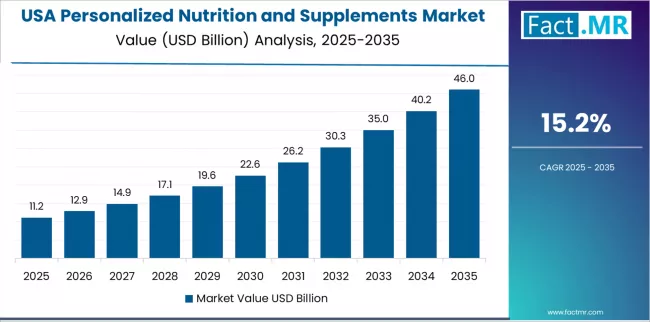
The USA’s advanced consumer health market demonstrates sophisticated personalized supplement deployment with documented effectiveness in preventive health and performance optimization applications through integration with existing healthcare infrastructure and wellness systems.
The country leverages technical expertise in genomic science and artificial intelligence to maintain a 15.2% CAGR through 2035. Wellness centers, including major digital health platforms, showcase advanced personalization capabilities where AI-driven recommendation systems integrate with comprehensive health assessment platforms and genetic testing services to optimize nutritional outcomes and preventive care effectiveness.
American consumers prioritize scientific validation and personalization accuracy in supplement selection, creating demand for premium personalized nutrition solutions with advanced features, including clinical-grade testing and integration with US healthcare provider networks. The market benefits from established research infrastructure and consumer willingness to invest in personalized wellness systems that provide long-term health benefits and data-driven outcome validation.
Strategic Market Considerations:
- Fitness optimization and chronic disease prevention segments leading growth with focus on performance enhancement and metabolic health applications
- Regional consumer preferences are driving a diverse product portfolio from basic vitamin personalization to comprehensive genomic-based protocols
- Regulatory validation challenges offset by domestic research partnerships and clinical trial initiatives
- Healthcare provider integration beginning to influence prescription-grade personalized supplement adoption and insurance reimbursement considerations
How will Growth Unfold in Japan?
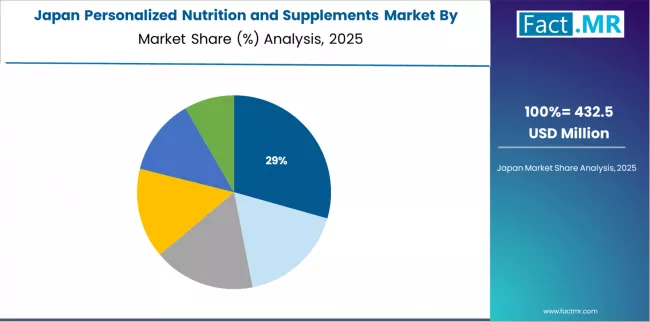
Japan’s market expansion benefits from diverse demographic demand, including aging population health maintenance and advanced nutraceutical adoption programs that increasingly incorporate personalized supplement solutions for longevity optimization applications.
The country maintains a 15.1% CAGR through 2035, driven by rising preventive healthcare awareness and increasing preference for scientifically validated personalization technologies through specialized pharmacy and wellness center channels.
Market dynamics focus on high-quality personalized supplements that balance advanced formulation technologies with rigorous safety standards important to Japanese consumers. Growing aging population health concerns create demand for specialized supplement systems targeting cognitive health, bone density maintenance, and age-related disease prevention.
Strategic Market Considerations:
- Geriatric health and cognitive optimization segments leading growth with focus on longevity and quality of life applications
- Regional consumer expectations are driving a diverse product portfolio from basic personalized vitamins to advanced anti-aging formulations
- Technology validation challenges offset by potential partnerships with Japanese pharmaceutical research institutions
- Healthcare system integration initiatives beginning to influence personalized supplement adoption in clinical preventive medicine protocols
How does Germany Demonstrate Preventive Healthcare Excellence?
Germany’s market expansion benefits from diverse health demand, including aging population management and preventive healthcare programs. The country maintains a 14.8% CAGR through 2035, driven by rising health consciousness and increasing adoption of personalized wellness benefits, including superior preventive care capabilities and reduced healthcare cost complexity.
Market dynamics focus on scientifically validated personalized supplements that balance advanced testing methodologies with evidence-based formulation approaches important to German consumers. Growing preventive healthcare emphasis creates demand for personalized systems integrated with medical supervision and comprehensive health monitoring.
Strategic Market Considerations:
- Preventive health and aging population segments leading growth with focus on chronic disease prevention and wellness optimization applications
- Regional regulatory requirements are driving a diverse product portfolio from pharmacy-grade personalized supplements to clinical nutrition protocols
- Technology validation challenges offset by potential partnerships with German research institutions and healthcare providers
- Government healthcare initiatives beginning to influence personalized nutrition integration into preventive medicine frameworks
How is Canada’s Market evolving on the Back of Nutritional Plan Subscription Models?
Canada demonstrates strong market development with a 14.5% CAGR through 2035, distinguished by consumers’ preference for subscription-based personalized vitamin services that integrate seamlessly with digital health platforms and provide convenient delivery systems. The market prioritizes transparency in ingredient sourcing, formulation science validation, and integration with comprehensive wellness platforms that reflect Canadian expectations for healthcare quality and consumer protection.
Canadian consumers focus on natural ingredient preferences and sustainability considerations in supplement selection, creating demand for premium personalized nutrition solutions with advanced features including organic certification and environmental responsibility. The market benefits from established healthcare infrastructure and consumer investment in preventive wellness technology that provides long-term health optimization benefits.
Strategic Market Indicators:
- Subscription-based delivery and digital wellness platform focus on convenient personalized vitamin systems with transparent ingredient profiles and sustainability credentials
- Integration requirements with existing healthcare provider networks and pharmacy distribution systems
- Emphasis on natural ingredient sourcing and long-term health outcome validation in established wellness applications
How will UK’s Dominance in the Health and Wellness Trend Space Generate Demand?
The UK’s market expansion benefits from diverse consumer demand, including fitness optimization programs and wellness trend adoption that increasingly incorporate personalized supplement solutions for health enhancement applications. The country maintains a 14.3% CAGR through 2035, driven by rising interest in health and wellness movements and increasing preference for data-driven nutrition approaches through specialized online wellness platforms.
The market prioritizes convenience and accessibility in personalized supplement delivery, creating demand for user-friendly health assessment tools and streamlined subscription services. Growing workplace wellness adoption and fitness culture expansion create opportunities for personalized systems targeting energy optimization and performance enhancement.
Strategic Market Considerations:
- Fitness optimization and workplace wellness segments leading growth with focus on performance and stress management applications
- Regional consumer preferences are driving a diverse product portfolio from basic personalized multivitamins to sport-specific formulation protocols
- Technology accessibility challenges offset by potential partnerships with UK digital health platforms and fitness organizations
- Healthcare provider engagement initiatives beginning to influence personalized supplement recommendations in primary care settings
Europe Market Split by Country
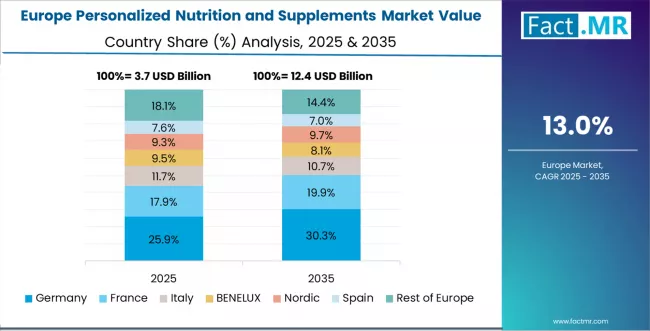
The personalized nutrition and supplements market in Europe is projected to grow from USD 4.8 billion in 2025 to USD 19.2 billion by 2035, registering a CAGR of 15.0% over the forecast period. Germany is expected to maintain its leadership position with a 31.4% market share in 2025, rising to 32.1% by 2035, supported by its advanced preventive healthcare infrastructure, comprehensive aging population wellness programs, and strong consumer emphasis on scientifically validated personalization throughout major metropolitan regions.
France follows with a 19.7% share in 2025, projected to reach 20.3% by 2035, driven by wellness culture adoption, digital health platform expansion, and growing consumer interest in precision nutrition serving both urban and regional markets. The UK holds a 18.9% share in 2025, expected to increase to 19.4% by 2035, supported by health and wellness trend proliferation and growing adoption of subscription-based personalized supplement services.
Italy commands a 13.2% share in 2025, projected to reach 13.7% by 2035, while Spain accounts for 9.6% in 2025, expected to reach 10.1% by 2035. The rest of Europe region, including Nordic countries, Eastern Europe, and smaller Western European markets, is anticipated to hold 7.2% in 2025, declining slightly to 4.4% by 2035, attributed to market consolidation toward larger core markets with established e-commerce infrastructure and personalized wellness technology capabilities.
Competitive Landscape of the Personalized Nutrition and Supplements Market
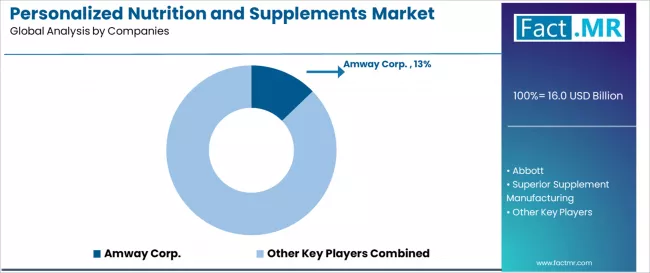
The personalized nutrition and supplements market is characterized by competition among established supplement manufacturers, digital health startups, and wellness technology companies focused on delivering high-quality, scientifically validated, and individually customized nutritional solutions.
Companies are investing in AI-driven formulation technology advancement, genetic testing partnerships, strategic digital health platform integration, and personalized customer service to deliver effective, convenient, and data-driven supplement solutions that meet stringent health outcome and consumer satisfaction requirements.
Scientific validation protocols, personalization algorithm optimization, and subscription service enhancement strategies are central to strengthening product portfolios and market presence.
Amway Corp. leads the market with a 12.8% market share, offering comprehensive personalized supplement solutions with a focus on nutritional science and direct-to-consumer wellness programs. Abbott provides specialized nutritional products with emphasis on medical-grade formulations and clinical research validation services.
Superior Supplement Manufacturing focuses on custom supplement production capabilities and white-label personalized formulation solutions for brands serving diverse consumer markets. Herbalife International of America, Inc. delivers nutrition and wellness products with strong distribution network capabilities and personalized coaching integration.
Metagenics, Inc. operates with a focus on bringing practitioner-grade personalized supplements to clinical healthcare applications and functional medicine markets. Fagron Genomics S.L.U. provides comprehensive genomic testing and DNA-based personalized nutrition services across multiple health optimization applications. Nutralliance specializes in custom supplement manufacturing and personalized formulation development for wellness brands with emphasis on quality differentiation.
DNAfit focuses on genetic testing integration and personalized wellness recommendations to enhance consumer access to DNA-based supplement optimization. Archer Daniels Midland Company and Viome Life Sciences, Inc. focus on ingredient innovation and microbiome-based personalization technologies for precision nutrition applications, emphasizing scientific advancement and health outcome validation through advanced testing and formulation strategies.
Key Players in the Personalized Nutrition and Supplements Market
- Amway Corp.
- Abbott
- Superior Supplement Manufacturing
- Herbalife International of America, Inc.
- Metagenics, Inc.
- Fagron Genomics S.L.U.
- Nutralliance
- DNAfit
- Archer Daniels Midland Company
- Viome Life Sciences, Inc.
Scope of the Report
| Items | Values |
|---|---|
| Quantitative Units (2025) | USD 15.97 Billion |
| Ingredient | Proteins & Amino Acids, Probiotics, Herbal/Botanicals, Vitamins, Minerals, Others |
| Dosage Form | Tablets/Capsules, Powders, Liquids, Others |
| Distribution Channel | Specialty Stores, Online Pharmacies & E-commerce Sites, Supermarkets/Hypermarkets, Retail Pharmacies |
| Age Group | Pediatric, Adults, Geriatric |
| Regions Covered | North America, Europe, Asia Pacific, Latin America, Middle East & Africa |
| Countries Covered | USA, Germany, UK, Japan, India, China, Canada and 40+ countries |
| Key Companies Profiled | Amway Corp., Abbott, Superior Supplement Manufacturing, Herbalife International of America, Inc., Metagenics, Inc., Fagron Genomics S.L.U., Nutralliance, DNAfit, Archer Daniels Midland Company, and Viome Life Sciences, Inc. |
| Additional Attributes | Dollar sales by ingredient, dosage form, distribution channel, and age group, regional demand trends, competitive landscape, consumer preferences for personalized supplement technologies, integration with digital health platforms, innovations in genetic testing, AI-driven formulation algorithms, and health outcome optimization |
Personalized Nutrition and Supplements Market by Segments
-
Ingredient :
- Proteins & Amino Acids
- Probiotics
- Herbal/Botanicals
- Vitamins
- Minerals
- Others
-
Dosage Form :
- Tablets/Capsules
- Powders
- Liquids
- Others
-
Distribution Channel :
- Specialty Stores
- Online Pharmacies & E-commerce Sites
- Supermarkets/Hypermarkets
- Retail Pharmacies
-
Age Group :
- Pediatric
- Adults
- Geriatric
-
Region :
-
North America
-
Europe
- Germany
- France
- UK
- Italy
- Spain
- Nordic
- BENELUX
- Rest of Europe
-
Asia Pacific
- China
- India
- Japan
- South Korea
- ASEAN
- Australia & New Zealand
- Rest of Asia Pacific
-
Latin America
- Brazil
- Argentina
- Chile
- Rest of Latin America
-
Middle East & Africa
- Kingdom of Saudi Arabia
- Other GCC Countries
- Turkey
- South Africa
- Other African Countries
- Rest of Middle East & Africa
-
link