
The prevalence of overweight children with obesity is increasing at an alarming rate, rendering juvenile obesity a significant public health issue globally. In the near term, this disease may result in several health issues, including type 2 diabetes, hypertension, and joint complications. Over time, it may also result in severe chronic illnesses such as cardiovascular disease, type 2 diabetes, and certain cancers1. Multiple variables contribute to childhood overweight and obesity. These elements encompass genetic, behavioural, and environmental influences that interact intricately2. The primary causes include poor dietary practices, insufficient physical activity, and social and environmental influences. Children are increasingly becoming overweight due to dietary shifts toward high-calorie, low-nutrient meals, reduced outdoor playtime due to urban living and more screen time3,4. There has been a significant increase in childhood obesity in China, particularly among preschoolers5. This increase parallels a global trend and reflects China’s distinct social, cultural, and economic transformations. Accelerated urbanisation, economic expansion, and alterations in living arrangements and familial structures have led individuals to consume more Western-style fast food and sugary beverages while simultaneously exhibiting reduced physical activity6,7. Until recently, legislation mandated that each family could have just one child. The regulation resulted in the solitary child frequently receiving the entirety of attention and resources from their parents and grandparents, thus leading to overfeeding and diminished physical activity. Moreover, a societal conviction exists in China that a well-nourished infant signifies health and affluence, exacerbating the issue further8. To combat childhood obesity in China, the following specific factors must be considered. The evidence indicates that public health initiatives must be culturally attuned and tackle the fundamental socioeconomic and lifestyle determinants contributing to this escalating epidemic. Parents’ Knowledge, attitudes, and behaviours toward health are pivotal in effectively managing their children’s body weight, as they directly influence their offspring’s dietary habits and physical activity. Informed parents are more likely to understand the importance of balanced nutrition and the dangers of excessive calorie intake, enabling them to make informed decisions about the food and portion sizes they offer. They can foster a healthful home environment by encouraging physical activity and limiting sedentary behaviours, which can influence health and fitness perceptions. Elliott9 posited that parents who adopt a nutritious diet and consistent exercise habits act as exemplars for their children, establishing a basis for healthy living inside the home. Behavioural modelling is crucial, as children often replicate the tendencies exhibited by their primary caregivers.
Knowledge, attitude, and practices (KAP) framework
The KAP survey, also known as the KABP [Knowledge, Attitudes, Beliefs, and Practices] survey, is a methodological tool initially created to study family planning practices globally by Ratcliffe10. The KAP framework is a sociological paradigm that evaluates how an individual’s Knowledge, attitudes, and behaviours (practices) regarding a subject might impact results in many sectors such as public health, education, environmental conservation, and marketing. The framework is highly beneficial for creating, executing, and assessing treatments and programs focused on modifying habits or enhancing results in a specific demographic11.
Knowledge refers to the information individuals possess regarding a specific subject or topic. It includes the Knowledge, data, and information that individuals or groups have. Knowledge may involve comprehending a disease’s aetiology and preventive strategies in public health. Attitudes refers to individuals’ feelings about a particular topic and inclinations toward specific actions or customs. Attitudes can be favourable or unfavourable and are shaped by personal beliefs, cultural conventions, and societal influences. They are essential in influencing an individual’s likelihood of adopting or altering new practices. Practices refer to the behaviours individuals engage in based on their knowledge and attitudes. This may encompass habits, rituals, and specific behaviours that are developed gradually.
Gaps of previous studies
Although a considerable body of literature has investigated the current childhood obesity epidemic, especially modifiable risk factors, some critical areas are still underexplored, especially the influence of parents. The first step in comprehending childhood obesity is to analyse parental knowledge, attitudes, and practices (P-KAP) and parental socioeconomic status (P-SES), which can contribute to children’s health behaviours.
Lack of research on P-KAP in the Asian context and preschool students
In recent decades, the KAP survey has emerged as an essential tool in public health research and program evaluation, offering significant insights into individuals’ health-seeking behaviours and the efficacy of public health interventions12,13. KAP surveys assess individuals’ Knowledge, attitudes, and practices concerning health issues, facilitating the identification of gaps in awareness, misconceptions, and behavioural impediments within communities14. By comprehending these elements, public health experts can formulate customised actions, guaranteeing that health programs adequately meet unique requirements and enhance long-term health results. KAP surveys are crucial for the design, execution, and ongoing assessment of health initiatives, enabling policymakers and healthcare practitioners to enhance resource allocation and augment the effectiveness of public health endeavours.
Investigations of the KAP framework have been undertaken across many locations, encompassing America15, Canada16, the Middle East17, and Europe18. Nonetheless, a notable research deficiency persists in examining how P-KAP affect childhood obesity, especially within the Asian context. Straughan and Xu19 emphasised that few studies have particularly investigated parental Knowledge, attitudes, and behaviours concerning obesity in Asia, creating a significant gap in comprehending the impact of parental influence on children’s health habits. Moreover, although research has examined the direct impact of P-SES on childhood obesity, insufficient focus has been directed towards how P-SES affects childhood obesity via P-KAP, especially among Chinese parents20,21.
No research to date has particularly utilised the KAP framework for preschool-aged children in this setting, despite early childhood being a critical developmental phase where parental influence on diet, physical activity, and overall health habits is most significant. Preschool-aged children predominantly depend on parental guidance for their dietary selections and lifestyle practices, rendering P-KAP a crucial factor in the risk of childhood obesity. The deficiency of research constrains the capacity of health professionals and policymakers to formulate effective, evidence-based programs to prevent childhood obesity from an early age.
Limitations of BMI as the sole indicator of obesity
Researchers frequently employ BMI as a principal metric for assessing obesity levels owing to its simplicity, cost-efficiency, and ease of computation. BMI evaluates height and weight to broadly evaluate body mass, applicable to persons of all ages and genders, with modifications for children based on age and sex percentiles. Nevertheless, BMI alone fails to distinguish between adipose tissue and lean tissue, which may result in misclassification, such as categorising muscular persons as overweight or overlooking extra body fat in those with a normal BMI.
BFP is an adjunct measure to mitigate this restriction, providing a more accurate body composition assessment by quantifying fat mass relative to total body weight. In contrast to BMI, BFP offers information on fat distribution, differentiating between subcutaneous and visceral fat, each with distinct metabolic and health consequences. Visceral fat increases the risk of metabolic diseases, including diabetes and cardiovascular disease.
Employing BMI and BFP concurrently improves obesity evaluation by distinguishing various obesity phenotypes, including persons with normal BMI yet elevated body fat (normal-weight obesity) and those with high BMI but reduced body fat (muscular build). This dual strategy allows researchers and healthcare practitioners to create more tailored obesity interventions, ensuring patients receive suitable counsel based on their real body composition rather than weight alone.
Lack of understanding of the mediating role of P-KAP in the relationship between P-SES and childhood obesity
Current studies often investigate the direct effects of P-KAP and P-SES on children’s BMI Z-SCORE, emphasising the independent influence of parental behaviours and socioeconomic factors on obesity prevalence. Nevertheless, there is a paucity of comprehension regarding the indirect mechanisms by which P-SES influences children’s BMI z-score through P-KAP, resulting in a significant void in the literature. P-SES is essential in determining parents’ access to health-related resources, Knowledge, and capacity to adopt healthy practices. Parents possessing elevated educational attainment and financial security are more inclined to obtain dependable health information, nutritious foods, organised physical activities, and high-quality healthcare services. Conversely, low-SES parents may encounter financial, educational, and environmental limitations that hinder their capacity to obtain or implement sufficient Knowledge regarding good diet, portion control, and physical activity guidelines. This knowledge gap may result in suboptimal feeding patterns, characterised by an overdependence on processed or high-calorie foods due to their price and convenience.
Furthermore, parental attitudes toward health and nutrition, influenced by socioeconomic conditions, affect the degree to which they prioritise healthy habits in the household. Parents from elevated socioeconomic status may regard obesity prevention as a crucial component of child development, prompting them to implement organised routines for food preparation, physical activity, and diminished screen time. In contrast, parents of lower socioeconomic status may possess an inadequate understanding or alternative conceptions of the risks associated with childhood obesity, thus underestimating the long-term repercussions of bad dietary practices and sedentary lifestyles. Parental behaviours, encompassing feeding patterns, food preparation routines, and activity encouragement, are the behavioural connection between parental socioeconomic status and childhood obesity outcomes. Families possessing superior financial and educational resources are more inclined to embrace health-promoting practices, such as preparing nutritionally diverse home-cooked meals and promoting organised physical activity. Conversely, low-SES families may contend with time limitations, food shortages, or insufficient safe play areas, resulting in increased dependence on fast food and screen-based entertainment, which contribute to childhood obesity. This study underscores the mediating function of P-KAP in the association between P-SES and childhood obesity, stressing that interventions must address not just socioeconomic disparities but also Knowledge, attitudes, and behavioural modifications. Addressing these mediating factors can offer a more holistic strategy for diminishing childhood obesity rates, especially among families of lower socioeconomic status.
This study
This study expands current literature by presenting a coherent conceptual framework delineating the links among P-SES, P-KAP, and childhood obesity. P-SES, which includes factors such as income, education, and occupation, affects the degree to which parents can obtain and implement health-related Knowledge and behaviours. P-KAP is a pivotal mediator that converts socioeconomic advantages (or disadvantages) into health consequences for children.
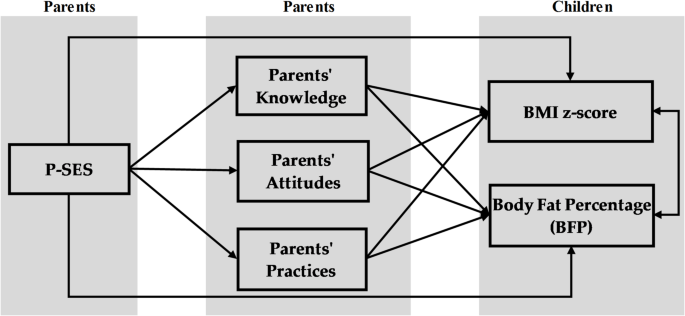
To enhance the theoretical foundation of this investigation, we utilise the Stimulus-Organism-Response (SOR) theory, which offers a systematic framework for comprehending how external stimuli influence internal cognitive and behavioural mechanisms, resulting in measurable outcomes. As per SOR theory, an external environmental component (stimulus) affects an individual’s internal state (organism), thereby prompting behavioural reactions22. This study applies the framework to address childhood obesity issues in preschool children in China, conceptualising P-SES as the stimulus (S), P-KAP as the organism (O), and children’s BMI z-score and BFP as the reaction (R).
In this scenario, P-SES is the external determinant of parents’ access to health-related Knowledge, attitudes, and practices. Parents from elevated socioeconomic situations typically possess superior education, financial security, and access to health-related information, influencing their comprehension and methodology regarding nutrition, physical activity, and overall child health practices. P-KAP denotes parents’ intrinsic cognitive and behavioural disposition, illustrating how their understanding and perspectives on health manifest in tangible activities, including food preparation, promotion of physical activity, and healthcare choices. Ultimately, children’s BMI z-score and BFP represent the definitive health outcomes influenced by parental factors stemming from their socioeconomic status.
By including SOR theory in this study, we offer a more thorough theoretical elucidation of how parental socioeconomic position affects childhood obesity via parental cognition and behaviour. This theoretical framework elucidates the mechanisms connecting parental socioeconomic conditions to childhood health outcomes and provides valuable insights for developing targeted interventions. The principal objective of this study is to investigate the mediating function of P-KAP in the association between P-SES and childhood obesity, thereby providing a more refined comprehension of how parental factors influence children’s health. This study enhances theoretical frameworks and practical implementations in developing treatments to mitigate socioeconomic inequities in childhood obesity prevention initiatives.
The current study intends to investigate the following:
-
1.
The relationship of P-SES with parents’ (a) knowledge, (b) attitude, and (c) practices among boys’ and girls’ preschool children.
-
2.
The relationship of parents’ Knowledge with (a) child’s BMI z-score and (b) child’s BFP among boys’ and girls’ preschool children.
-
3.
The relationship of parents’ attitudes with (a) child’s BMI z-score and (b) child’s BFP among boys’ and girls’ preschool children.
-
4.
The relationship of parents’ practices with (a) child’s BMI z-score and (b) child’s BFP among boys’ and girls’ preschool children.
-
5.
The mediating roles of parents’ Knowledge, attitudes, and practices between P-SES and the child’s BMI z-score.
-
6.
The mediating roles of parents’ Knowledge, attitudes, and practices between P-SES and children’s BFP.
The proposed model is depicted in Fig. 1.

link